
|
Lot: 93 ♡
|
|||||||||||
|
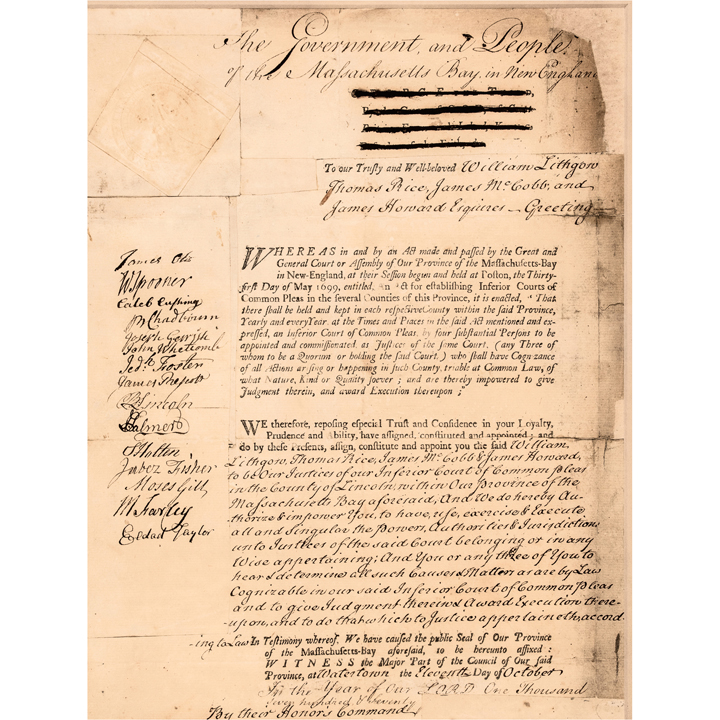
Important October 11, 1775-Dated Massachusetts Council Commission Signed by Fifteen Council Members, a New Paul Revere Made Provincial Seal & King's Name Removed
|
|||||||||||
|
|||||||||||
 |
|
||||||||||
|
Lot 93:
Important October 11, 1775-Dated Massachusetts Council Commission Signed by Fifteen Council Members, a New Paul Revere Made Provincial Seal & King's Name Removed
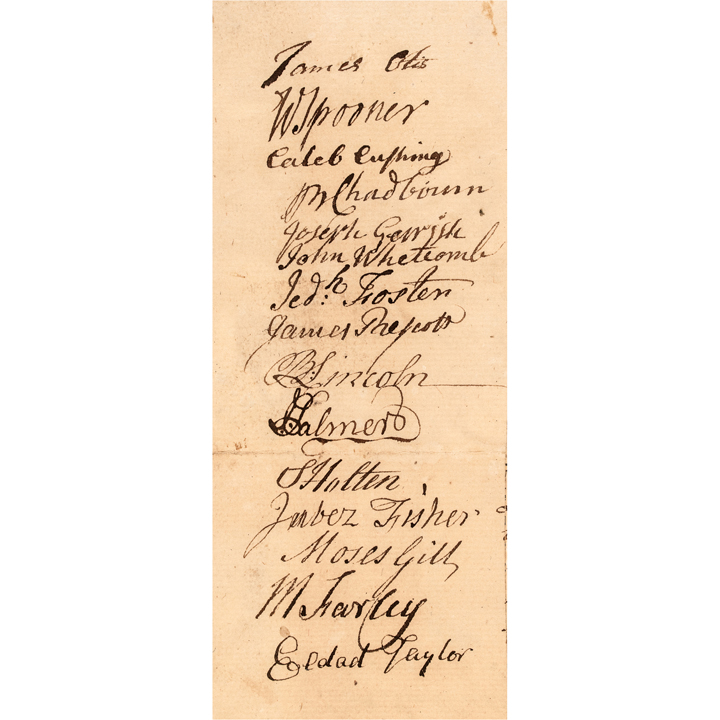
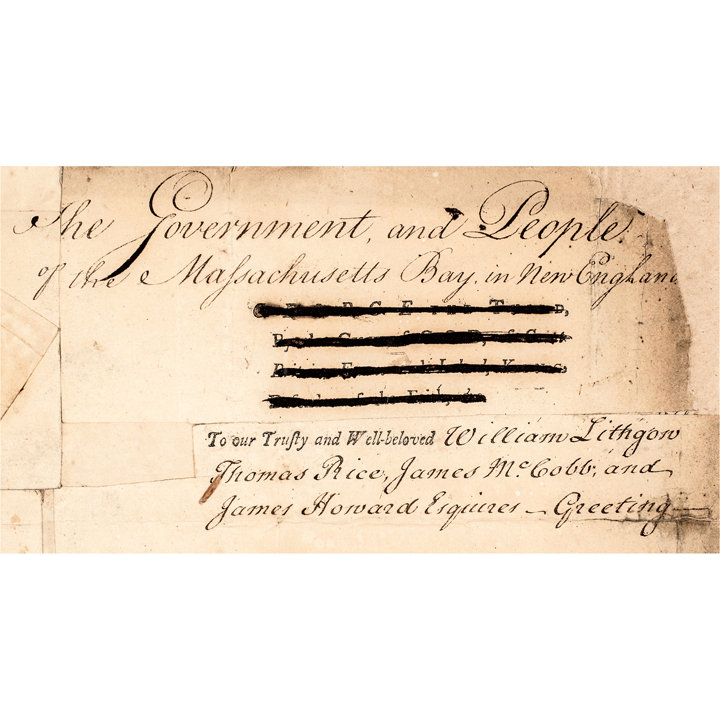
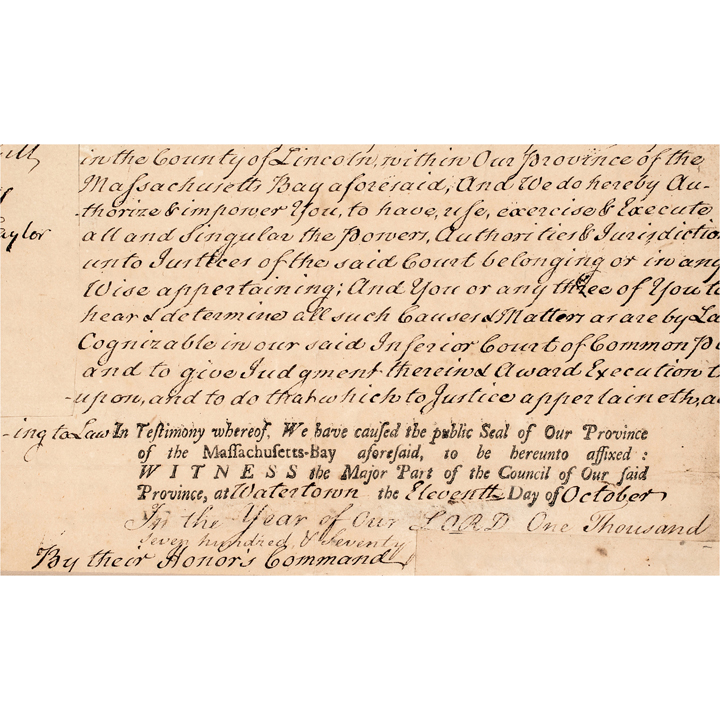
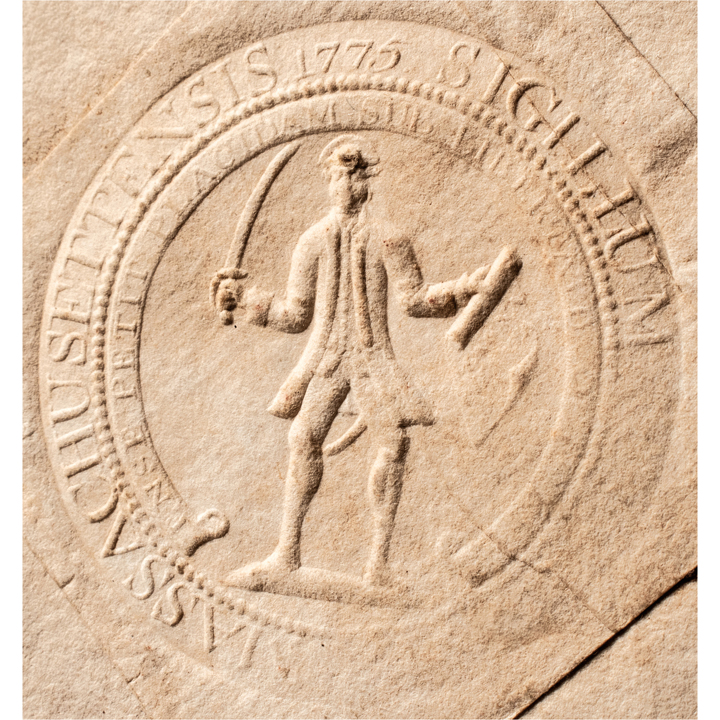
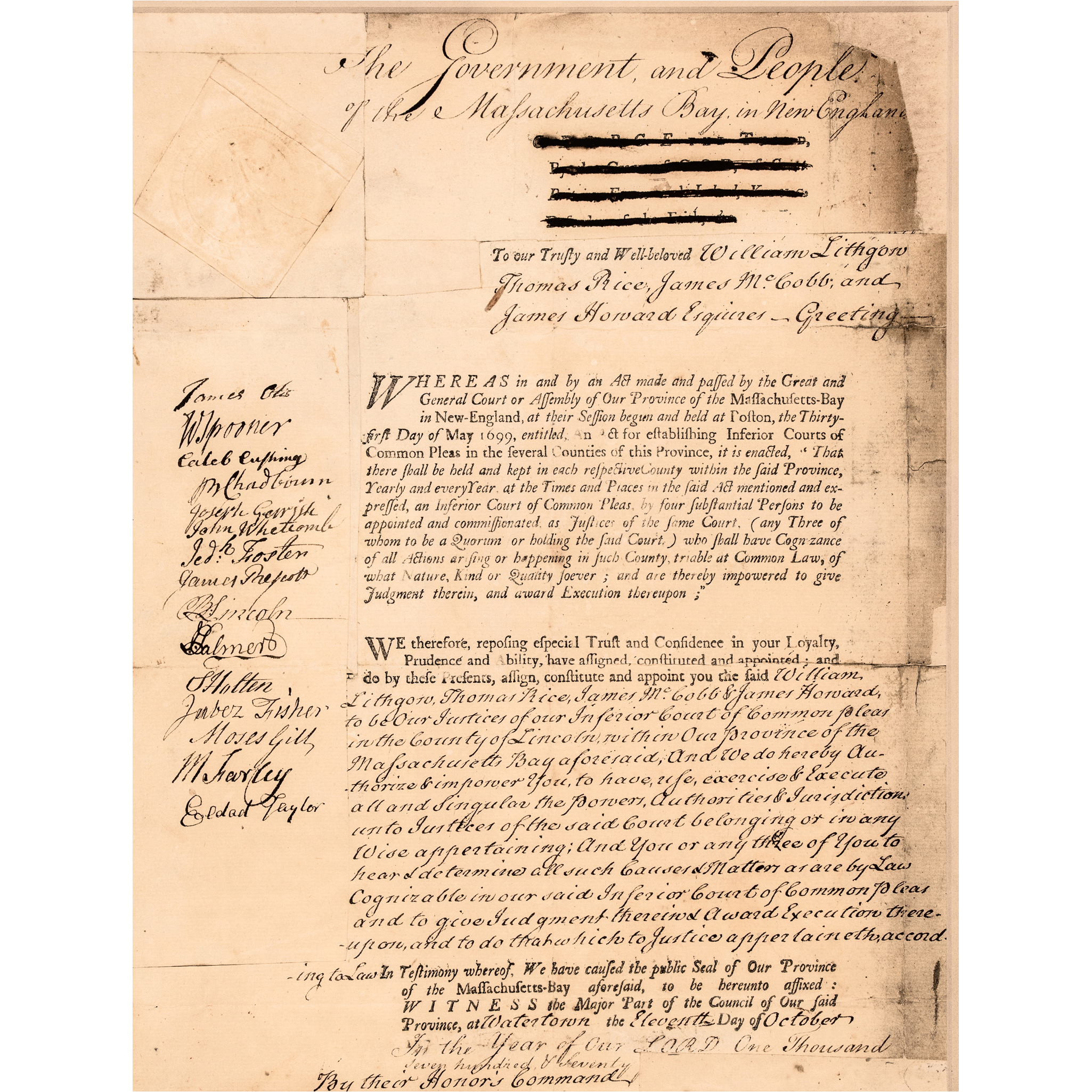
October 11, 1775-Dated Revolutionary War, Partially-Printed Massachusetts Provincial Council Commission appointing Four Justices, Signed by Fifteen Council Members, having the Paul Revere Engraved Provincial Embossed Seal at upper left and the King's name and titles Hand-struck out of the printed text, Framed, Fine. October 11, 1775 Revolutionary War date Massachusetts Provincial Council fully Signed Commission. Printed in black typeset with strong brown ink signatures and manuscript text. This document is conserved having been seperated in five sections, each laid down on a large backing sheet. The viewable sections combine to measure 14 x 10.5 inches (by sight) and in a decorative period style frame to fully 19 x 15 inches. Officially appointing; William Lithgow, Thomas Rice, James McCobb, and James Howard Esquires, all as Justices of the Inferior Court of Common Pleas for the County of Lincoln, Province of the Massachusetts Bay. This Provincial Council Commission was struck off from a printed typeset form originally headed for issuance under the Royal Government of George III, in October of 1775 with an important historical "correction" due to the Revolutionary War needed to be made, where the King's name and titles that were originally printed across four lines heading the sheet as a Royal Commission, needed removal. By October 1775, however, Massachusetts no longer recognized British authority, and the King's name has been crossed through in heavy ink rather than having a new revised form printed. In the document's closing clause, the old Royal Seal has likewise been replaced: (the old seal remained in the custody of Royal Governor Thomas Gage, whose authority the Province was no longer acknowledged), the signature for the governor cut off of the document. The General Court ordered a new Provincial Seal on July 28, 1775, the seal design being prepared and then engraved in a copper die by Paul Revere, which is shown with good clarity at the upper left. Now depicting an American “Minuteman” figure grasping his Sword in one hand and a copy of the “Magna Carta” in his other hand. beneath the new motto, "Ense petit placidam sub libertate quietem." meaning roughly "By the sword we seek peace, but peace only under liberty." This document is dated not at the hand of a Governor, as Massachusetts did not have one then, but: "by the Major Part of the Council of Our said Province," the phrasing itself recording the fact that the colony's elected Council was, at that moment, collectively standing in for an executive that no longer existed and the location on this document where he was to sign was trimmed off. The Commission is Signed at lower left by Fifteen Members of that Council, headed by James Otis, Sr., father of the celebrated patriot orator James Otis, Jr. and President of the Council at that time, and followed by Walter Spooner, Caleb Cushing, [Chadbourne], Joseph Gerrish, John Whitcomb, Jedediah Foster, James Prescott, Benjamin Lincoln, [Palmer], Samuel Holten, Jabez Fisher, Moses Gill, Michael Farley, and Eldad Taylor. Several rose to further prominence, Benjamin Lincoln as a Continental Army Major General present at the British surrender at Yorktown, Samuel Holten as a Continental Congress delegate and signer of the Articles of Confederation, and Moses Gill as Lieutenant Governor and, upon Increase Sumner's death in office, Acting Governor of Massachusetts. The four appointees named in the commission were themselves leading men on the Lincoln County frontier of present-day Maine, William Lithgow foremost among them, a longtime judge of the Lincoln County Court of Common Pleas and later a militia general during the Revolution. Beneath its routine business of naming four county judges, the commission stands as a small, physical monument to a government inventing itself on the fly, the single sheet recording, in ink and paper rather than in later history books, the moment Massachusetts crossed out a king and stamped in his place a sword, a Magna Carta, and the signatures of fifteen men governing, for the time being, by committee. Provenance: Collection of Ambassador J. William Middendorf II. This document cites an underlying 1699 Act of the General Court that had established the County Trial Courts to hear civil disputes over property, debts, and similar everyday matters. Here, specifically empowering any three of the four named justices to hold court as a quorum even absent the fourth. An very important historic feature of this document is the Paul Revere made Seal for the Provincial Council requested the Copper Die to be made on July 28th, 1775 with the design completed by Paul Revere on August 5, 1775. The committee tasked with the design included Major James Otis, Dr. John Winthrop, and Major Joseph Hawley. It is notable that James Otis is the first and top signer of the council members on this document. On July 28, 1775, the Massachusetts Provincial Congress, acting as the revolutionary government's "General Court" since royal authority had collapsed after Lexington and Concord passed an order appointing a committee to consider "what is necessary to be done relative to a Colony Seal." This was necessary because Royal Governor Thomas Gage still held custody of the old provincial seal, and with his authority no longer recognized, the colony needed its own. The seal was engraved by Paul Revere, and his original signed bill for the work is preserved in the Massachusetts Archives. Revere just months removed from his midnight ride, was working as a silversmith and engraver at the time, and he produced the copper plates for the new seal. The design adopted showed an English-American man holding the Magna Carta. More specifically, it depicted an Anglo-American Minuteman holding an upraised broadsword in his right hand and a copy of the Magna Carta in his left, the patriot figure wearing a tricorn hat. The imagery paired revolutionary armed resistance (the raised sword) with the assertion of English liberties and legal rights (the Magna Carta). Accompanying the seal was a new Latin motto, "Ense petit placidam sub libertate quietem," meaning roughly "By the sword we seek peace, but peace only under liberty," a phrase written around 1659 and attributed to the English patriot Algernon Sidney. That motto is still the Commonwealth's motto today. Worth noting: this 1775 Provincial Seal wasn't the final Massachusetts state seal. After the 1780 Massachusetts Constitution, the legislature commissioned a new design from Nathan Cushing, approved by Governor John Hancock on December 13, 1780, and Paul Revere was again brought in to engrave it, this time reverting to a Native American figure, which became the basis of the State Seal used today. This October 11, 1775-Dated Massachusetts Council Commission Reads in Full: (Printed Heading:) “The Government, and People / of the Massachusetts Bay, in New England (Note: Four lines, struck-through in heavy manuscript ink; originally the King's name and Royal titulature, now illegible beneath the dark strikeout.) To our Trusty and Well-beloved William Lithgow, Thomas Rice, James M'Cobb, and James Howard Esquires - Greeting - WHEREAS in and by an Act made and passed by the Great and General Court or Assembly of Our Province of the Massachusetts-Bay in New-England, at their Session begun and held at Boston, the Thirty-first Day of May 1699, entitled, An Act for establishing Inferior Courts of Common Pleas in the several Counties of this Province, it is enacted, "That there shall be held and kept in each respective County within the said Province, Yearly and every Year, at the Times and Places in the said Act mentioned and expressed, an Inferior Court of Common Pleas, by four substantial Persons to be appointed and commissionated, as Justices of the same Court, (any Three of whom to be a Quorum or holding the said Court,) who shall have Cognizance of all Actions arising or happening in such County, triable at Common Law, of what Nature, Kind or Quality soever; and are thereby impowered to give Judgment therein, and award Execution thereupon;" “WE therefore, reposing especial Trust and Confidence in your Loyalty, Prudence and Ability, have assigned, constituted and appointed; and do by these Presents, assign, constitute and appoint you the said William Lithgow, Thomas Rice, James M'Cobb & James Howard, to be Our Justices of our Inferior Court of Common Pleas in the County of Lincoln, within Our Province of the Massachusetts Bay aforesaid, And We do hereby Authorize & impower You, to have, use, exercise & execute all and singular the Powers, Authorities & Jurisdictions unto Justices of the said Court belonging or in any Wise appertaining; And You or any Three of You to hear & determine all such Causes & Matters as are by Law Cognizable in our said Inferior Court of Common Pleas and to give Judgment thereon & award Execution thereupon, and to do that which to Justice appertaineth, according to Law. In Testimony whereof, We have caused the public Seal of Our Province of the Massachusetts-Bay aforesaid, to be hereunto affixed: WITNESS the Major Part of the Council of Our said Province, at Watertown the Eleventh Day of October In the Year of Our LORD One Thousand Seven hundred, Seventy[-five]. By their Honor's Command - (Left-hand column, lists the fifteen signatures, including:) James Otis W. Spooner Caleb Cushing M. Chadbourn[e] Joseph Gerrish John Whetcomb Jed:h Foster James Prescott B. Lincoln C. Palmero S. Holten Jabez Fisher Moses Gill M. Farley Eldad Taylor (Note - At Upper left, Embossed/impressed provincial Paper and Red Wax Seal, oval, partially legible: outer border reading in fragments "MASSAHUSETTS... SIS 1775 SIG[ILLUM]..." and an inner ring with further somewhat weaker embossed lettering; consistent with the 1775 provincial seal of Massachusetts, engraved by Paul Revere, depicting an English-American figure holding a sword and a copy of Magna Carta, encircled by the motto “ENSE PETIT PLACIDAM SUB LIBERTATE QUIETEM”. On May 1, 1776, the General Assembly adopted a resolution declaring Independence in the name of "The Government and People of the Massachusetts Bay in New England". This was later followed by the United States Declaration of Independence on July 4, 1776. The Seal of “Our Provence of the Massachusetts-Bay” is displayed in the uppeer left-hand corner. The Resolution is addressed to William Lithgow, Thomas Price Hon. William Lithgow (c. 1715 - December 20, 1798) was a judge for the Court of Common Pleas of Lincoln County, when Maine was under the jurisdiction of the Province of Massachusetts Bay. Lithgow also served in the Massachusetts Bay Colonial Militia for twenty years before and during the French and Indian War. |
|||||||||||
|
Auction Closing: Saturday, November 14th
at Noon Eastern Time • 9:00 AM Pacific Time |
|||||||||||