
|
Lot: 95 ♡
|
|||||||||||
|
Rare Signed Rum Requisition for American Soldiers at “Fort Washington” New York 1776 that Historic Battle was one of the Worst American Patriot Revolutionary War Defeats
|
|||||||||||
|
|||||||||||
 |
|
||||||||||
|
Lot 95:
Rare Signed Rum Requisition for American Soldiers at “Fort Washington” New York 1776 that Historic Battle was one of the Worst American Patriot Revolutionary War Defeats
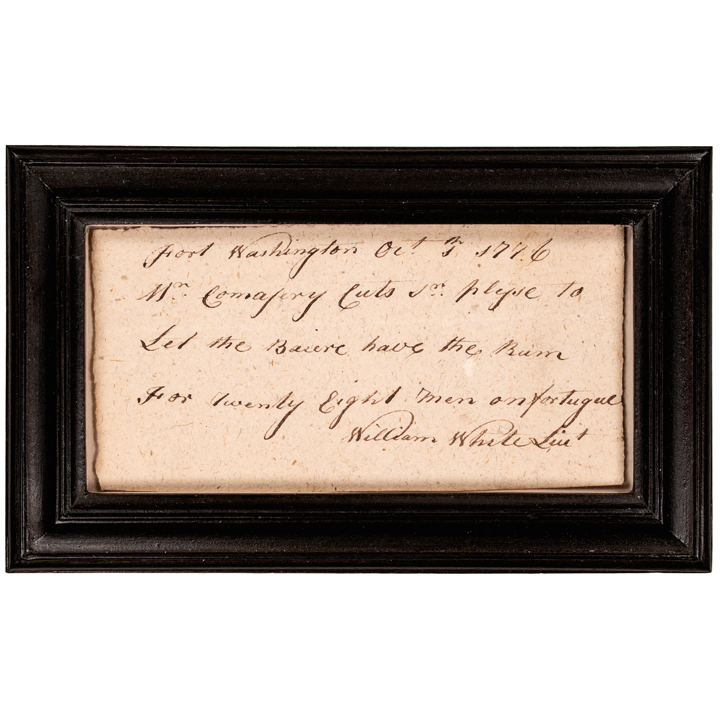
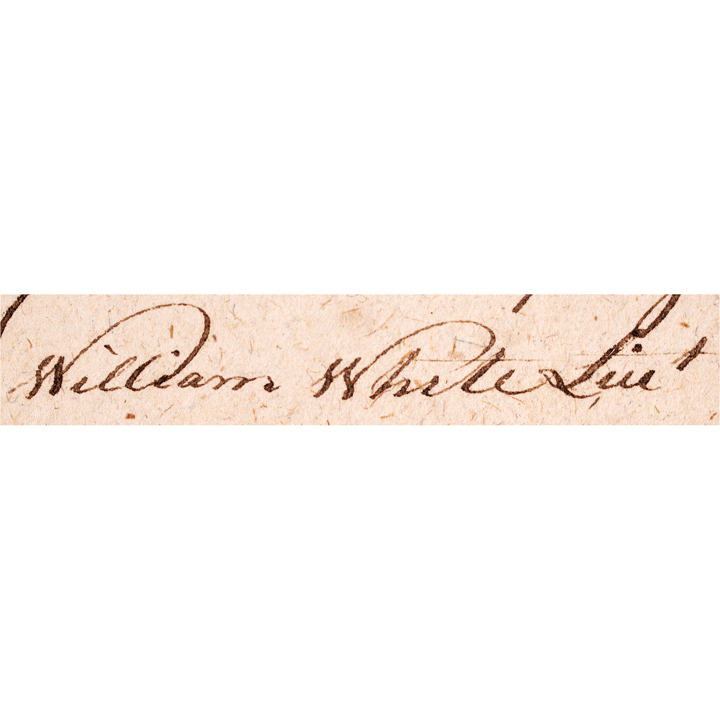
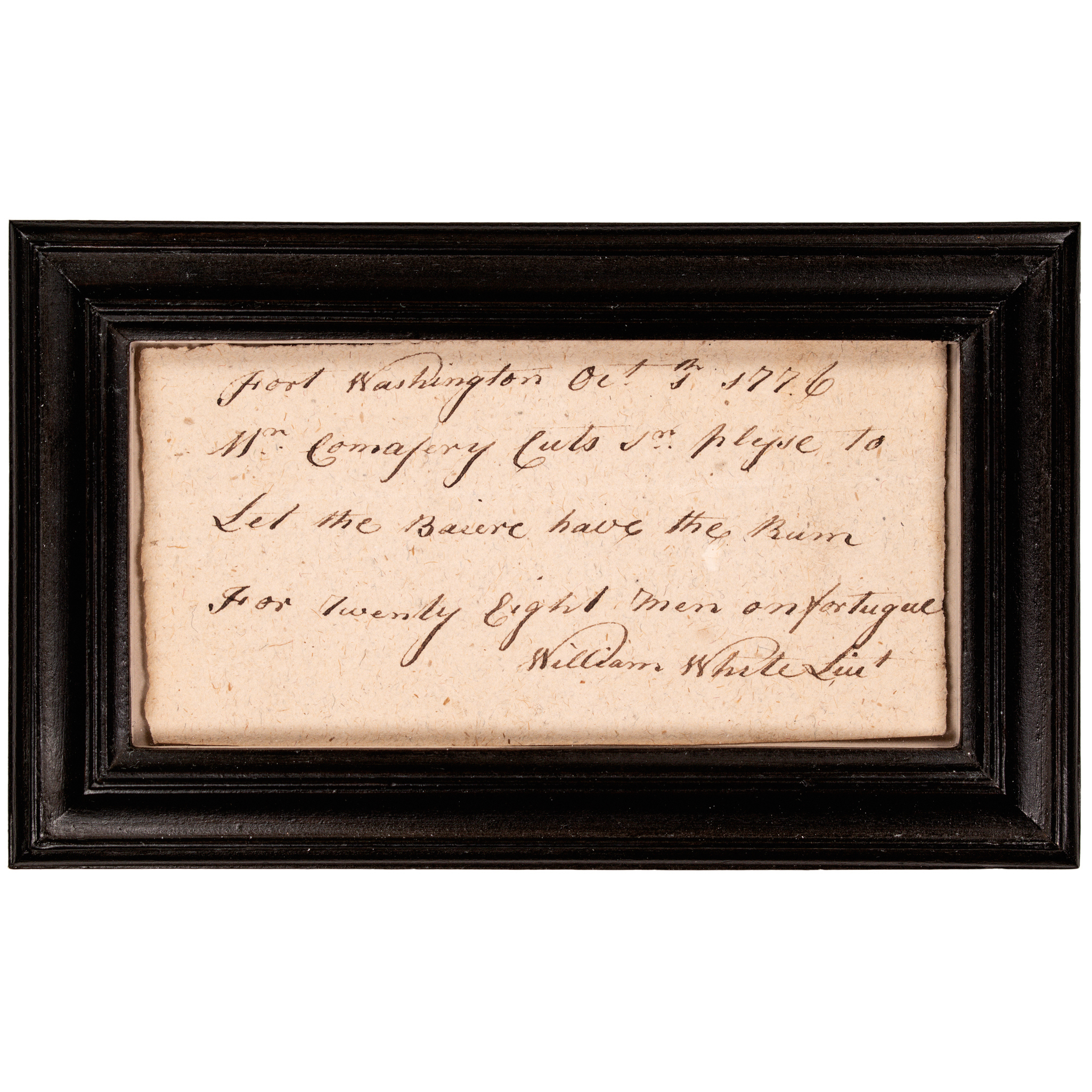
October 1st, 1776-Dated Revolutionary War Autographed Document Signed, “William White” as Continental Army Lieutenant stationed at Fort Washington near the north end of Manhattan, requesting Rum for 28 Men, just six weeks before one of the worst Patriot defeats of the Revolutionary War, Framed, Extremely Fine. The historic American Revolutionary War Battle of “Fort Washington” was fought in New York City on November 16th, 1776. In June 1776, American Patriot Continental Army officers Henry Knox, Nathanael Greene, William Heath, and Israel Putnam examined the terrain on which Fort Washington would be constructed, located near the north end of Manhattan, New York City. They agreed that if the fort was properly fortified, it would be practically impossible to be taken by the British. However, in the coming battle it was a British victory that gained the surrender of the remnant of the Continental Army garrison of Fort Washington. Hessian Colonel Johann Rall (Later the commander of Hessian Troops who was killed at the Battle of Trenton just over a month later) was given the honor of requesting the American surrender This battle was ultimately considered one of the worst Patriot defeats of the Revolutionary War. This rare handwritten requisition request is for “the Rum for Twenty Eight men” to be sent. This original document is well written in rich deep brown ink on very clean period cotton rag paper. It measures 5” x 2.5” and is nicely framed under protective Plexiglas to fully 6.5” x 4” housed in a simple dark brown decorative brown frame. It reads, in full (some poor spelling included): “Fort Washington - Octr. 1st 1776 --- Mr. Comasary Cuts sm, Pleyse to Let the Baiere (a person carrying a bag or drink or supplies) have the Rum for Twenty Eight Men on fortuque -- (Signed) William White Lieut(enant)” During the American Revolutionary War, Fort Washington was located at the highest point of the island of Manhattan, along a large outcropping of Manhattan schist near its northernmost tip. Along with Fort Lee, located just across the Hudson River atop the New Jersey Palisades, the twin forts were intended to protect the lower Hudson from British warships. In June 1776, American Patriot officers Henry Knox, Nathanael Greene, William Heath, and Israel Putnam examined the terrain on which Fort Washington would be located; they agreed that if the fort was properly fortified, it would be practically impossible to take. Later in June, the Commander-in-Chief of the Continental Army, George Washington, inspected the location and determined that the area was the key to defense of the lower Hudson. Shortly after Washington's survey, troops from Pennsylvania began construction on the fort under the supervision of Rufus Putnam. After defeating the Continental Army under Commander-in-Chief General George Washington at the Battle of White Plains, the British forces under the command of Lieutenant General William Howe planned to capture Fort Washington, the last American stronghold on Manhattan. General Washington issued a discretionary order to General Nathanael Greene to abandon the fort and remove its garrison, which then numbered 1,200 men but which later grew to 3,000, to New Jersey. Colonel Robert Magaw, acting commander of the fort, refused to abandon it, believing his troops would be able to defend it from the British. British General Howe's forces attacked the fort before Washington could arrive to assess the situation on November 16th, 1776. Howe led an assault from three sides: the north, east and south. The tides of the Harlem River prevented some troops from landing and delayed the attack. When the British moved against the defenses, the southern and western American defenses fell quickly, and the obstacles meant to deter an attack were bypassed with ease. Patriot forces on the north side offered stiff resistance to the Hessian attack, but they too were overwhelmed. With the fort surrounded by land and sea, Colonel Magaw chose to surrender. A total of 59 Americans were killed in action and 2,837 were taken as prisoners of war. George Washington, who was watching the battle from the other side of the river, sent a note to Magaw asking him to hold out until nightfall, thinking that the troops could be evacuated during the night. By this time, the Hessians had taken the ground between the fort and the Hudson River. Hessian Colonel Johann Rall was given the honor of requesting the American surrender by Knyphausen. Johann Rall sent Captain Hohenstein, who spoke English and French, under a flag of truce to call for the fort's surrender. Hohenstein met with Cadwalader, and Cadwalader requested that Magaw be given four hours to consult with his officers. Hohenstein denied the request and gave the Americans a half hour to decide. As Magaw was consulting with his officers, Washington's messenger, Captain John Gooch arrived, just before the fort was completely surrounded, with Washington's request to hold out until nightfall. Magaw attempted to get easier terms for his men, who would only be allowed to keep their belongings, but this failed. Magaw announced his decision to capitulate at 3:00 pm, and at 4:00 pm, the American flag was brought down in the fort, replaced by the British flag. Before the surrender, John Gooch leaped off the side of the fort, tumbled to the bottom of the cliff, evaded musket fire and bayonet stabs, and got onto a boat, arriving at Fort Lee a short while later. After this defeat, a large portion of George Washington's army was pursued across New Jersey and into Pennsylvania, while the British consolidated their control of New York Harbor and eastern New Jersey. |
|||||||||||
|
Auction Closing: Saturday, November 14th
at Noon Eastern Time • 9:00 AM Pacific Time |
|||||||||||