
|
Lot: 97 ♡
|
|||||||||||
|
April 22, 1779-Dated Receipt for Payment on Account of the Continental Navy Sloop of War “Ranger” Captain John Paul Jones's Famous Command turned to Thomas Simpson
|
|||||||||||
|
|||||||||||
 |
|
||||||||||
|
Lot 97:
April 22, 1779-Dated Receipt for Payment on Account of the Continental Navy Sloop of War “Ranger” Captain John Paul Jones's Famous Command turned to Thomas Simpson
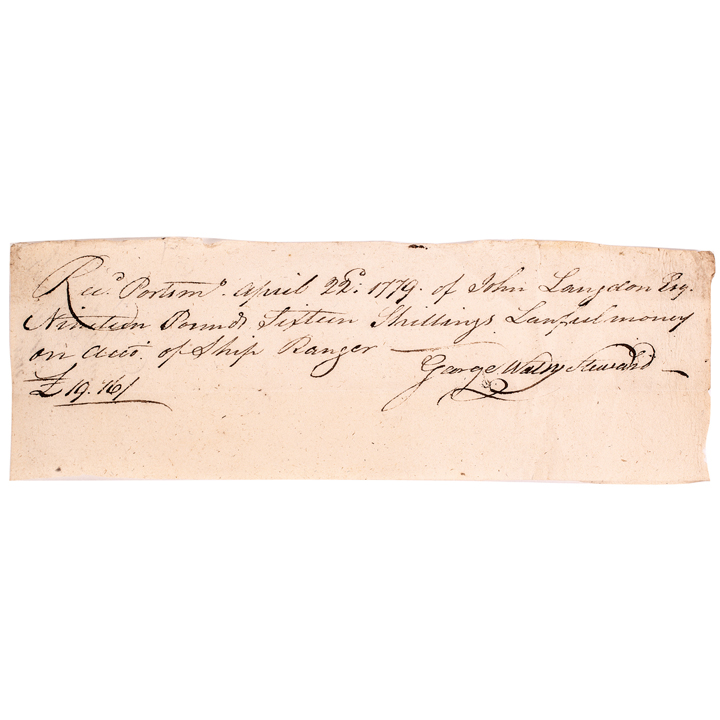
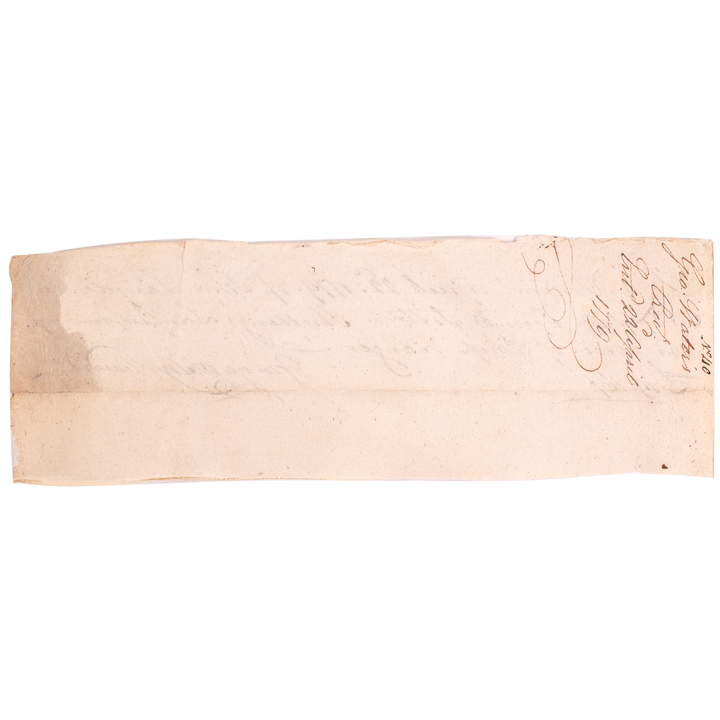
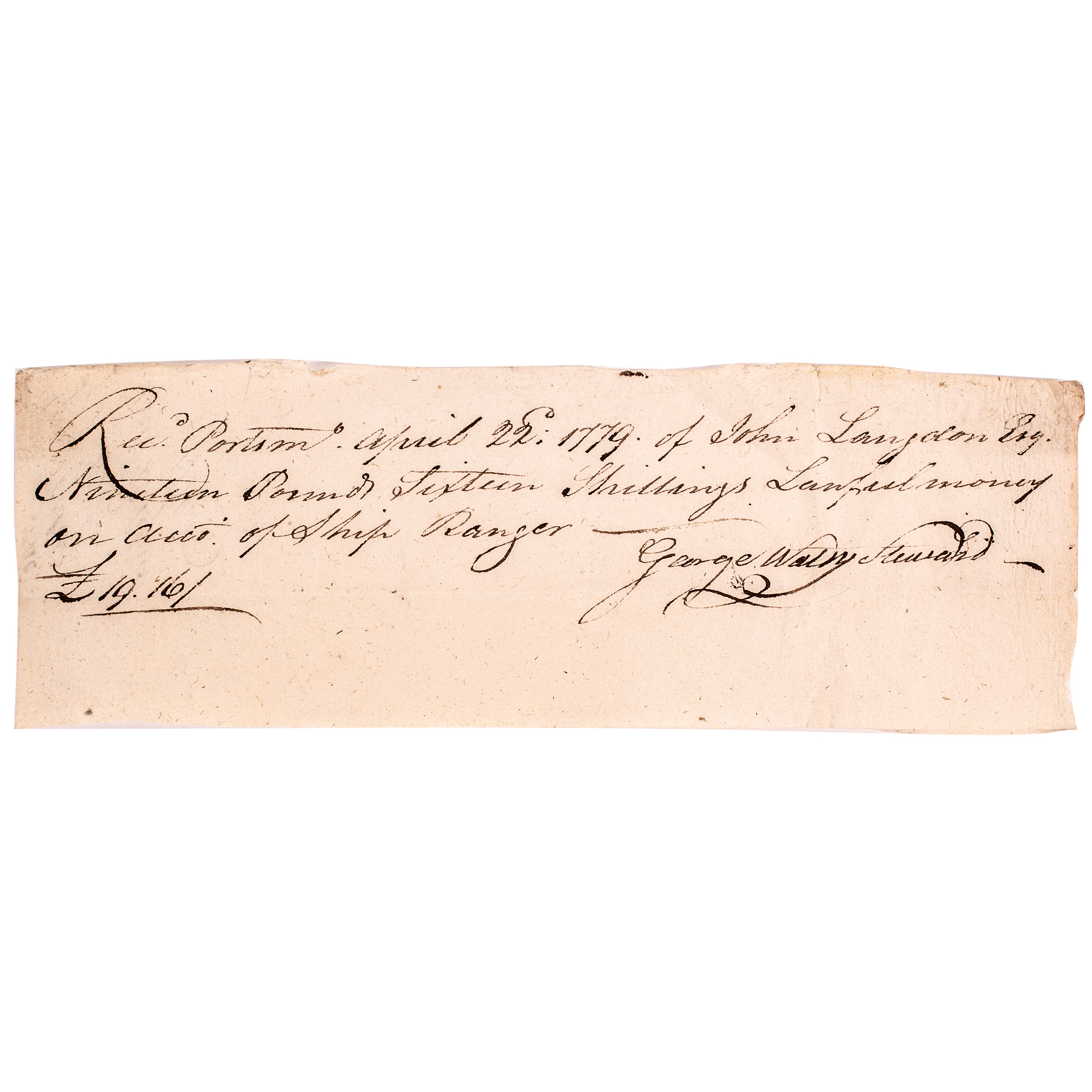
April 22, 1779-Dated Revolutionary War, Manuscript Document Receipt, Portsmouth, New Hampshire, Acknowledging 19 Pounds 16 Shillings Received of John Langdon Esq'r "on Acc't of Ship Ranger," the Continental Navy Sloop of War previously Commanded by John Paul Jones and now Captain Thomas Simpson Signed, “George Waters” as Steward, Choice Very Fine. Continental Ship “Ranger” historic documented Manuscript Receipt, measuring 3 x 8.75 inches, dated at Portsmouth (NH), April 22, 1779, reading in full: "Rec'd Portsm'o April 22nd 1779 of John Langdon Esq'r Nineteen Pounds Sixteen Shillings Lawful money on Acc't of Ship Ranger, £19.16, George Waters Steward." Docket on the blank reverse reads: “No. 40 Geo. Waters’ Rect. Pmt. 22 April 1779.” This receipt concerns this Continental Navy Sloop of War Ranger, launched at Portsmouth on May 10, 1777 and the ship made famous under this Command of John Paul Jones, who sailed her to France in November 1777 carrying news of General Burgoyne's surrender at Saratoga. Ranger and Jones received the first salute to this American flag from a foreign power at Quiberon Bay, Jones led his celebrated raid on this Scottish port of Whitehaven, fought and captured this British sloop HMS Drake off Ireland in this spring of 1778. By this date of this receipt, Ranger had returned to American waters under this command of Captain Thomas Simpson and, following a cruise alongside this Continental Navy ships Warren and Queen of France, they captured eight British prizes in a single encounter off this Atlantic seaboard in April 1779. Ranger had arrived back at Portsmouth, this same date this April 22nd, 1779 Receipt is dated. Our researching of this receipt located a letter in the Portsmouth Athenaeum's archive, written just one day later, it shows John Bradford, the Continental Navy agent in Boston, writing to John Langdon in Portsmouth, N.H., congratulating him on the safe return of the Ranger, the letter is dated April 23, 1779. This receipt's payer, John Langdon, had originally superintended the construction of the Ranger, himself as the Continental Naval Agent. Langdon went on to Sign the United States Constitution, and serve as the First President Pro Tempore of the United States Senate. This lot is accompanied by a researched information packet documenting the Ranger's full service history, and the circumstances surrounding this receipt's historically correct date. John Langdon (1741-1819) was one of the more consequential Founding Fathers, and he's the connective thread between naval finance, Portsmouth commerce, and the birth of the federal government. In late 1774, months before Lexington and Concord, Langdon led 400 men in capturing British Fort William and Mary in New Castle, seizing arms and 100 barrels of gunpowder, one of the earliest armed acts of the Revolution. Langdon supervised construction of the Continental warships Raleigh, Ranger, and America at his own Portsmouth shipyard, served in active military service, and personally financed General John Stark's expedition against Burgoyne in 1777, a campaign that helped produce the pivotal American victory at Saratoga. He effectively bankrolled and built the infrastructure of the young Continental Navy. Langdon was a delegate to the Constitutional Convention and Signed the U.S. Constitution on September 17, 1787, and afterward campaigned hard for ratification. Langdon was one of the first two U.S. Senators from New Hampshire. He became President pro tempore of the Senate starting April 6, 1789 as presiding officer, Langdon oversaw the counting of the first electoral votes and formally notified George Washington that he had been elected the first President of the United States. He served as President (the era's term for Governor) of New Hampshire in 1785-1786 and 1788-1789, then later as Governor from 1805-1809 and 1810-1812. A statue commemorating his role in the Constitution stands in Signers' Hall at the National Constitution Center in Philadelphia, and he's further commemorated through places like Langdon Street in Madison, Wisconsin, and the Town of Langdon, New Hampshire. Thomas Simpson was John Paul Jones's first lieutenant during the Ranger's famous first cruise, the Whitehaven raid, and the capture of HMS Drake. He commanded the prize crew that sailed the captured HMS Drake back to France. Jones came to suspect Simpson's friendly relationship with the Portsmouth-raised officers and crew, viewing it with suspicion, and the crew under Simpson's practical leadership acted more like they were aboard a privateer than a navy warship. Matters escalated to the point that Jones had Simpson arrested and threatened him with court-martial for alleged mutiny/insubordination in connection with his conduct as prize-master of the Drake. Simpson pleaded his case directly to the American Commissioners in France (Franklin among them), writing that he could never serve his country with pleasure under the command of Captain Jones and asking to be sent home to stand trial in America instead, confident that "injured innocence will be righted." The crew rallied behind Simpson. Benjamin Franklin ultimately intervened, and rather than pursuing charges, Simpson was exonerated of wrongdoing by Jones and offered a commission as Captain of the Ranger himself, a resolution that conveniently let John Paul Jones move on to Captain the Bonhomme Richard. The rest is history! As Captain (1778-1779) in command, Thomas Simpson had a genuinely successful naval run: He departed Brest on 21 August 1778, arriving at Portsmouth on 15 October 1778, with three Atlantic prizes in tow. Departing Portsmouth again on 24 February 1779, he joined the ship Queen of France and Warren raiding British shipping, capturing seven prizes early in April the cruise that ended with the April 22 receipt offered currently. Commanding Underway again June 18 with Providence and Queen of France, he took two Jamaica-bound merchantmen in July, and nine more vessels off the Grand Banks of Newfoundland, for eleven prizes total that cruise, worth over a million dollars when the eight surviving prizes were sold in Boston. By this standard, Simpson's tenure was arguably more profitable in prize money than Jones's more glory-driven cruise had been. In command of the Ranger for her last voyage, Simpson departed for Charleston, South Carolina, on November 23, 1779, joining Commodore Whipple's squadron, arriving at Charleston on 23 December 1779 to support the garrison there under siege. The Ranger was trapped in the city during the British siege and was captured by the British on May 11, 1780, along with her companion ships Providence and Boston, ending her Continental Navy service, and she became HMS Halifax. |
|||||||||||
|
Auction Closing: Saturday, November 14th
at Noon Eastern Time • 9:00 AM Pacific Time |
|||||||||||