
|
Lot: 98 ♡
|
|||||||||||
|
Circa 1780 Rare American Broadside Ballad, “Captain James, Who Was Hung in Gibbets in England for Starving to Death His Cabbin Boy.”, by Nathaniel Coverly, Jr., Boston
|
|||||||||||
|
|||||||||||
 |
|
||||||||||
|
Lot 98:
Circa 1780 Rare American Broadside Ballad, “Captain James, Who Was Hung in Gibbets in England for Starving to Death His Cabbin Boy.”, by Nathaniel Coverly, Jr., Boston
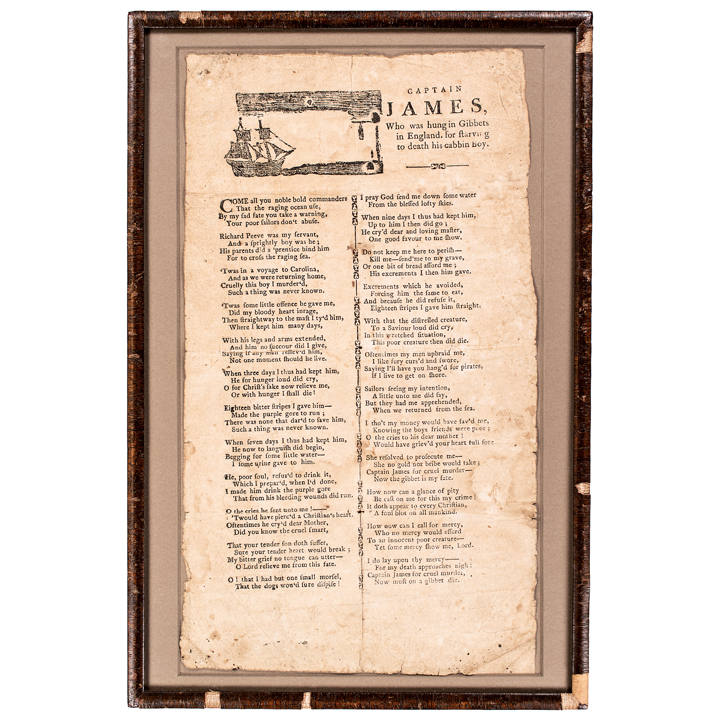
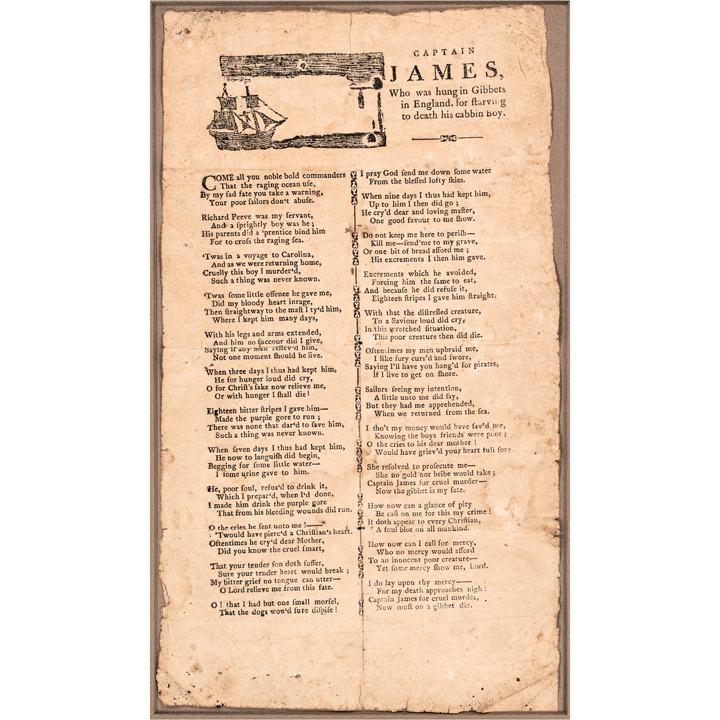
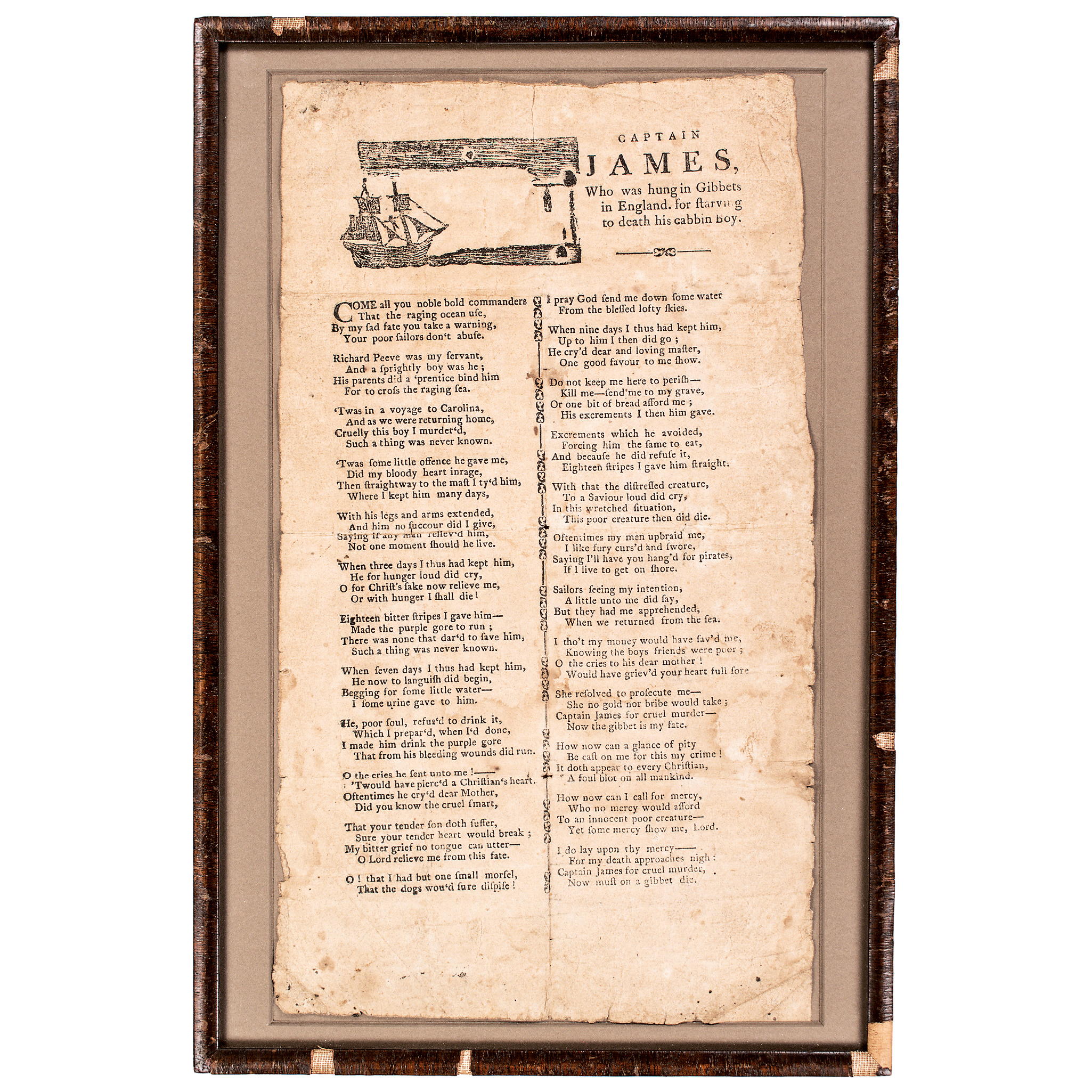
c. 1780, Exceedingly Rare Printed Broadside Ballad titled, "CAPTAIN JAMES, Who Was Hung in Gibbets in England for Starving to Death His Cabbin Boy (sic)” by Nathaniel Coverly, Jr., Boston" being Illustrated with a Woodcut of a Sailing Ship and Gibbet, Recounting the Hanging of a Sea Captain for Starving His Cabin Boy, Richard Peeve, to Death Aboard Ship, Framed, Boston Printing, Fine. The title is using "gibbeted" as a past-tense verb, describing a form of punishment, not a location. Gibbeting (also called "hanging in chains") was a practice where the body of an executed criminal was displayed in an iron cage or suspended in chains from a gallows-like post, left to decay in public as a warning to others. This was usually done at a crossroads, on a hilltop, or near the scene of the crime wherever would maximize visibility to travelers, not in any single fixed "Gibbets" location. So the title "Captain James, Who Was Hung and Gibbeted in England" means: Captain James was hanged (executed), and his body was then gibbeted (displayed in chains/cage) somewhere in England. Only one institutionally documented copy could be traced, held by the American Antiquarian Society, in the Isaiah Thomas Broadside Ballads Collection, printed in Boston by Nathaniel Coverly, Jr. (Milk Street, near Theatre Alley), previously identified as dated to 1780 although others of this form run to roughly 1814. The full sheet appears to be on laid period paper, its size measuring about 14” x 8”, 1 page, with a single Woodcut illustration at top left (a sailing ship and gallows scene). It's cataloged there as BIB ID 274873 and cross-referenced in W.C. Ford's bibliography of Isaiah Thomas's ballad collection. This apparently semi-unique example may well be the only available in public hands. It is period wood framed showing some distressed portions to the wood grain and professionally double-matted and displayed under special TRU-VUE UV Plexiglas, not examined out of its 16” x 10.5” frame. It has its full wide margins having uniform light tone and is well printed with clear black text and a sharp vignette as shown, attracting ex: Secretary of the U.S. Navy Middendorf’s attention per is harsh nautical theme. This ballad text runs beneath this woodcut in two columns of verse, opening "Come all you noble bold commanders / That this raging ocean use," and unfolding, in this captain's own confessional voice, his torture and starvation of his young servant Richard Peeve aboard ship on a voyage to Carolina, this boy's pleading for water and bread, his death from abuse and starvation, this crew's eventual apprehension of this captain on their return to shore, and his conviction and sentence to hang in gibbets for this murder. This victim's name varies between surviving copies of this ballad, appearing elsewhere as Pavy, Pevee, or Paddy Spry, and this grim tale was later drawn upon by Richard Henry Dana Jr. for a passage in Two Years Before this Mast (1840). This broadside remains a vivid survival of this English crime-ballad tradition, this song still being collected from traditional singers in England and New Brunswick well into this twentieth century (Roud 835), and prized today for its woodcut and macabre subject as much as for its rarity in this original printed state. Provenance: Ex Collection of J. William Middendorf II. An extremely rare English Broadside Ballad measuring titled "Captain James," illustrated at head with a woodcut vignette of a full-rigged sailing ship beside a gallows-frame gibbet, beneath which appears this caption, "Who was hung in Gibbets in England, for starving to death his cabbin boy." This macabre street ballad was printed on English broadsides around 1780 to 1814, part of this once-thriving trade in execution literature sold cheaply to the English public, this being a rare American Boston printing. Gibbeting (also called "hanging in chains"), the practice was formalized in England by the Murder Act of 1751, which let judges add gibbeting as a punishment beyond just execution for murder. It was abolisheinin 1834- the last person gibbeted in England was James Cook, in Leicestershire in 1832. Roughly 16 physical gibbets (or fragments/replicas) survive today in English local museums, but they're scattered - Yorkshire, Norfolk, Oxfordshire, and elsewhere - reflecting how the punishment was carried out wherever the crime or trial occurred, not at one specific "Gibbets" site. |
|||||||||||
|
Auction Closing: Saturday, November 14th
at Noon Eastern Time • 9:00 AM Pacific Time |
|||||||||||